 English
 Español
 عربى
 中文简体


Cosmetic Spray Bottle Specification Guide: Dose, Neck Finish and Material
Content
- 1 What a Cosmetic Spray Bottle Actually Is
- 2 Dose per Stroke Is the First Number to Fix
- 3 Neck Finish Decides Fit, Torque and Leak Rate
- 4 Atomization Quality Rests on Three Tolerances
- 5 PP, PETG, ABS and PCR: Choose by Fill, Not by Looks
- 6 Card Bottles and Perfume Tubes Cover the Travel Segment
- 7 Where Customization Actually Changes Cost
- 8 Five Checks Before the First Production Run
- 9 Direct Answers for Buyers
A pump rated at 0.12 ml per stroke that drifts by 0.02 ml overruns a 30,000-bottle run by roughly 600 ml, which is enough to break a declared fill weight and send a batch back to rework. That tolerance is why a cosmetic spray bottle is specified from the dispensing engine outward: dose first, then neck finish, then material, then decoration.
What a Cosmetic Spray Bottle Actually Is
A cosmetic spray bottle is an assembled dispensing package of container, pump or crimp valve, actuator and overcap that delivers 0.05 to 0.50 ml of liquid per actuation without a propellant.
The four parts carry four different failure modes, which is why a purchase order that names only capacity and colour tends to come back with a leak complaint or a weak spray. The container sets capacity, resin compatibility and decoration area. The engine sets dose, spray angle and leak resistance. The actuator sets the impression in the hand during the first second of use. The overcap sets protection between the filling line and the shelf.
Definition used throughout this guide: a cosmetic spray bottle is identified by its neck finish and its dose per stroke, not by its volume. Two bottles at the same 100 ml capacity with a 24/410 and a 28/410 neck accept different pumps and behave differently on the same filling line.
Six values belong on the specification sheet before any quotation is requested, because each one eliminates a category of supplier that cannot meet the brief:
- Capacity in ml, with the fill volume and headspace stated separately
- Neck finish code, such as 24/410, 28/410 or a 15 mm crimp collar
- Target dose in ml per stroke, with an allowed tolerance
- Spray cone in degrees and target droplet range in micrometres
- Dip tube length in mm, measured against the actual bottle height
- Resin grade that will contact the formula, plus any PCR percentage
Dose per Stroke Is the First Number to Fix
A fine mist pump for toner or setting spray should deliver 0.10 to 0.13 ml per stroke; below 0.08 ml the spray reads as weak, and above 0.16 ml it wets the face and wastes formula.
Dose is produced by three tolerances that interact: orifice diameter, spring preload and actuator stroke length. Adjust one and the other two must be re-validated, which is why a supplier that quotes a dose without quoting the actuator is quoting half a component.
| Format | Capacity | Dose per stroke | Neck finish | Typical fill |
| Perfume atomizer | 5-30 ml | 0.05-0.08 ml | 15 mm crimp | Fragrance, samples |
| Fine mist pump | 30-150 ml | 0.10-0.13 ml | 24/410 | Toner, setting spray |
| Card spray bottle | 10-38 ml | 0.09-0.11 ml | 20 mm | Pocket sanitizer, mist |
| Lotion pump | 30-250 ml | 0.20-0.50 ml | 24/410, 28/410 | Serum, emulsion |
| Powder pump | 30-100 ml | 0.10-0.15 g | 24/410 | Body powder, SPF |
Neck Finish Decides Fit, Torque and Leak Rate
24/410 and 28/410 screw necks cover most cosmetic spray bottles, while fragrance atomizers use 13, 15, 18 or 20 mm crimp collars; the two families are not interchangeable and cannot be adapted with a gasket.
The first number in a screw code is the neck diameter in millimetres and the second is the thread profile code. A 28/410 bottle will not accept a 24/410 pump at any torque setting, and forcing the fit distorts the collar within days of shipping. Our cosmetic spray pump types and selection guide maps actuator families to these finishes.
| Neck finish | Connection | Typical engine | Product example |
| 13 mm | Crimp | Micro atomizer | Sample vial fragrance |
| 15 mm | Crimp | Perfume atomizer | 5-30 ml fragrance |
| 20 mm | Screw | Card bottle pump | Pocket spray |
| 24/410 | Screw | Fine mist, lotion | Toner, serum |
| 28/410 | Screw | Fine mist, lotion | Body spray, hair mist |
Closure torque on a 28/410 pump is typically specified between 1.0 and 1.5 N·m. Under-torque lets the gasket breathe and produces a slow weep at the collar; over-torque deforms the thread and cracks the collar within a week of transport. Ask for the torque value in writing, then verify it on ten units from each cavity.
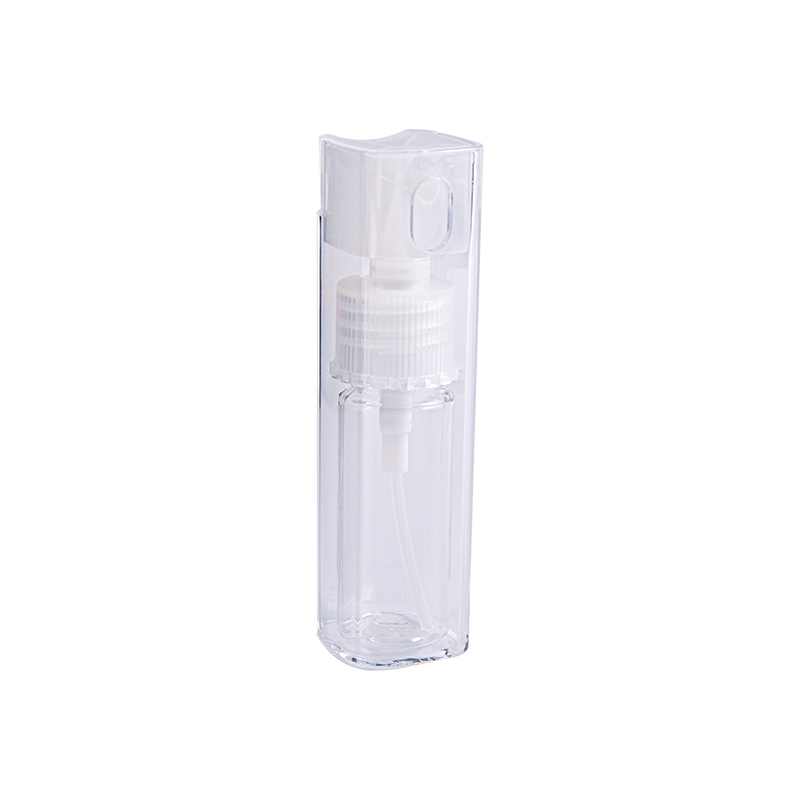 Precision 10–40 ml Plastic Spray Bottle SeriesMulti-material 10–40 ml spray bottles with precision micro-dispensing, PET or glass inner bottles, and ABS shells for cosmetics, personal care, and reagent packaging.View Product →
Atomization Quality Rests on Three Tolerances
A cosmetic-grade fine mist sits between 40 and 90 micrometres of droplet diameter with a spray cone of 50 to 70 degrees; finer mists drift on air currents and coarser ones leave visible wetting on skin.
- Orifice diameter sets the base droplet size and must be held within a few micrometres across cavities
- Spring preload sets the pressure curve through the stroke, so a soft spring produces a sputter at the end of travel
- Dip tube bore, usually 1.5 to 2.0 mm, sets priming speed and how much product is left behind at the end of life
- Vent geometry sets whether the bottle draws air back cleanly or pulls formula into the collar
Leak paths are few and predictable: closure gasket, valve seat, dip tube joint and vent hole. A 30-second vacuum check at minus 0.3 bar catches all four before decoration, when a reject is still worth recovering.
Dip tube length is the most common specification error. Cut it to the bottle height plus 1 to 2 mm so the tube curves slightly against the base; a tube that touches the corner will leave 0.5 to 1.5 ml unreachable and a tube that stops short will sputter before the bottle is empty.
PP, PETG, ABS and PCR: Choose by Fill, Not by Looks
PP handles most alcohol-free toners and emulsions, PETG is chosen when glass-like clarity is the selling point, and ABS belongs on overcaps and collars rather than in sustained solvent contact.
PP, the workhorse
- Broad chemical resistance to emulsions and mild surfactants
- Flexible body that survives a 1.2 m drop without shattering
- Translucent rather than water-clear, so colour reads as milky
- Lowest unit cost across the 10 to 250 ml range
PETG, the showcase
- Clarity close to glass, which suits fragrance and serum
- Higher stiffness, so the body feels substantial in hand
- More sensitive to aggressive solvents and to stress cracking
- Needs a gentler drop test and thicker wall at the shoulder
PCR grades are quoted by percentage, commonly 30%, 50% or 100%, and each step shifts colour and odour. Treat a PCR switch as a full re-validation rather than a drop-in substitution: run the compatibility test again, then check the spray cone, because recycled resin changes the neck roundness that the pump gasket relies on. Our material selection service exists for exactly this decision.
Shaoxing Shangyu Haibo Spray Plastic Co., Ltd., founded in 1995 and based in Shangyu, Zhejiang, produces these components across seven series and more than 100 variants, with exports to Germany, the United States, Japan, Hungary and other EU markets. The plant sits 35 km from Ningbo Port, which keeps ocean freight lead times short for European and North American buyers.
Card Bottles and Perfume Tubes Cover the Travel Segment
Card-format spray bottles run 10 to 16 ml for pocket sizes and 20 to 38 ml for larger versions, and the resin choice changes both the flex of the flat body and the clarity of the fill.
The flat profile is the commercial point: it slides into a bag pocket, holds a label across a wide face, and still accepts a standard 20 mm pump. A dust cap adds about 1.5 mm of height and removes the accidental actuation that ruins a handbag lining, so for retail travel sets it is usually specified as standard.
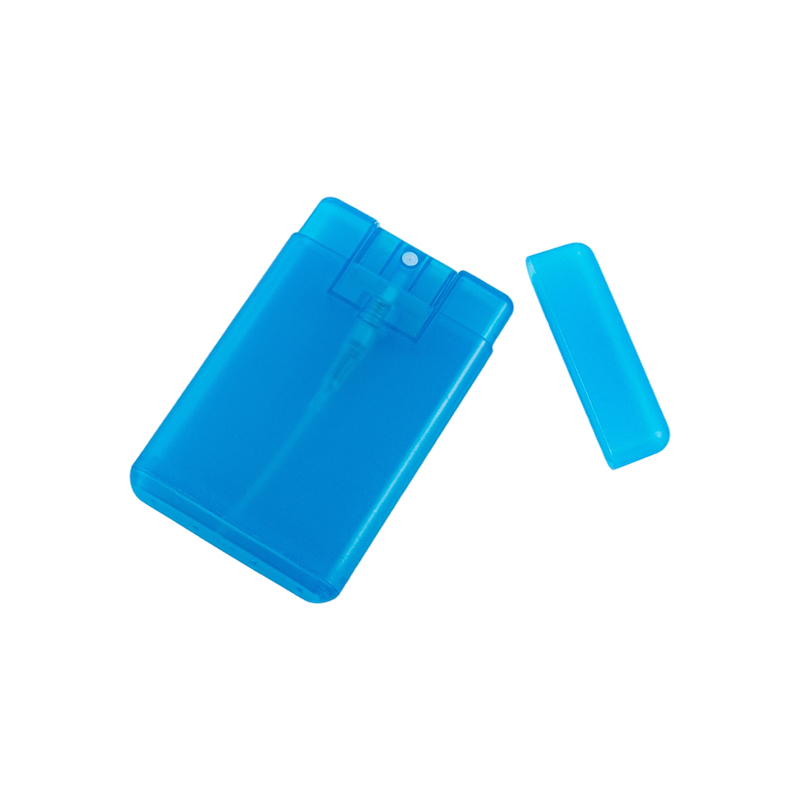 Flat Card-Style Spray Bottle with Dust CapFlat 20/30 ml PP spray bottle with dust cap, protecting the nozzle for portable oral, disinfectant, perfume-sample, and cleaning uses.View Product →
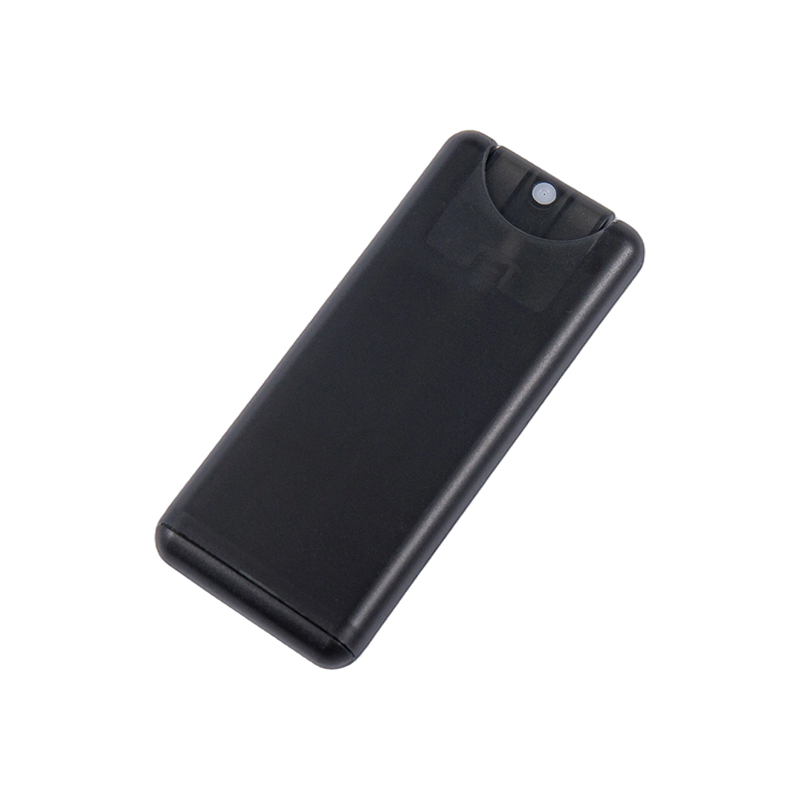 Ultra-Thin 10–16 ml PP Card Spray BottleUltra-thin 10–16 ml PP card-type spray bottle, only 11 mm thick, for portable perfume, oral spray, disinfectant, and travel refill use.View Product →
Perfume tubes solve the same problem in a narrower form. The hook-type set runs 8 to 10 ml and the pen-clip set 8 to 15 ml, both in PP, with tube diameters of 12, 13 and 14 mm matched to heights of 73, 77 and 87 mm. Those dimensions let a brand build a three-size travel line on one filling nozzle.
Where Customization Actually Changes Cost
Appearance customization, colour matching, functional upgrade and material selection are four separate cost lines, and only two of them normally touch tooling.
- Appearance customization changes the outer silhouette, so it moves the mould and the sampling cycle with it
- Colour matching is a masterbatch and decoration issue, priced per run rather than per tool
- Functional upgrade changes dose, stroke or closure behaviour, which requires new spring or orifice tooling
- Material selection changes compatibility, drop performance and clarity, and usually requires fresh validation data
Rule of thumb for quoting: colour and decoration change the run cost, while wall thickness, neck finish and dose change the tool. Ask which of the four lines your brief crosses before approving a sample.
A brand moving from a 100 ml round bottle to a flat card format crosses two lines at once, because both the mould and the pump seat change. A brand recolouring the same bottle crosses one. Sequencing those changes across two production cycles is usually cheaper than combining them.
Five Checks Before the First Production Run
Sampling 30 units per cavity and running five checks catches the defects that survive incoming inspection and appear only after a month in a warehouse.
- Dose check: actuate 20 strokes from a primed unit, weigh the output and confirm it sits inside the declared band
- Leak check: hold the filled unit at minus 0.3 bar for 30 seconds and inspect the collar, valve seat and dip tube joint
- Drop check: 1.2 m onto a hard floor, once on the base and once on the shoulder, with the actuator locked
- Compatibility check: four weeks at 40 degrees Celsius with the real formula, then re-check dose and spray cone
- Torque check: verify closure torque at 1.0 to 1.5 N·m on ten units per cavity and record the value
Record the results against the cavity number, not against the batch. A single-cavity drift in orifice diameter shows up as a 0.01 ml dose difference that is invisible in a batch average and obvious in a cavity log.
Direct Answers for Buyers
What dose should a cosmetic spray bottle deliver?
A fine mist pump for toner or setting spray should deliver 0.10 to 0.13 ml per stroke, a fragrance atomizer 0.05 to 0.08 ml, and a lotion pump 0.20 to 0.50 ml. Anything outside those bands changes how the product feels in use.
Which neck finish is most common for cosmetic spray bottles?
28/410 dominates body and hair mists, 24/410 dominates facial toners and serums, and 15 mm crimp collars dominate fragrance. A 20 mm screw neck is the usual choice for flat card bottles between 10 and 38 ml.
How much does a card spray bottle hold?
Small card bottles hold 10 to 16 ml and large card bottles hold 20 to 38 ml. Both accept PP, ABS and PETG bodies, and the resin choice determines whether the fill reads clear or milky.
How is a spray bottle tested before a bulk order?
Sample 30 units per cavity and run five checks: dose per stroke, a 30-second vacuum leak test at minus 0.3 bar, a 1.2 m drop test, four weeks of formula compatibility at 40 degrees Celsius, and closure torque between 1.0 and 1.5 N·m.





All rights reserved © Shaoxing Shangyu Haibo Spray Plastic Co.,Ltd.Privacy OEM/ODM Spray Plastic Bottle & Pump Manufacturers
浙ICP备2021023122号